Book 'Thall' is all about life experiences
Mumtaz Hussain Khyal
CESANO MODERNO (Italy): Punjabi poetry is a rich and vibrant part of the cultural heritage of Punjab, a region that spans across northern India and Pakistan. It encompasses a wide range of themes, styles, and historical periods, reflecting the diverse experiences and emotions of the Punjabi people. This poetic tradition is notable for its deep emotional resonance, lyrical beauty, and profound philosophical insights.
One of the most significant aspects of Punjabi poetry is its oral tradition, which dates back centuries. Early Punjabi poets often composed and recited their verses in the form of folk songs, ballads, and epics. These works were typically performed at social and religious gatherings, playing a crucial role in preserving the cultural memory and identity of the community. The oral tradition also allowed for the incorporation of local dialects and idiomatic expressions, making the poetry accessible and relatable to the masses.
The medieval period saw the emergence of some of the most revered poets in Punjabi literature. Baba Farid, a 12th-century Sufi saint, is considered one of the pioneers of Punjabi poetry. His works, known for their spiritual depth and simplicity, continue to inspire readers and listeners today. Another iconic figure is Guru Nanak, the founder of Sikhism, whose hymns and verses form a significant part of the Guru Granth Sahib, the holy scripture of the Sikhs. His poetry emphasizes the values of equality, humility, and devotion to God.
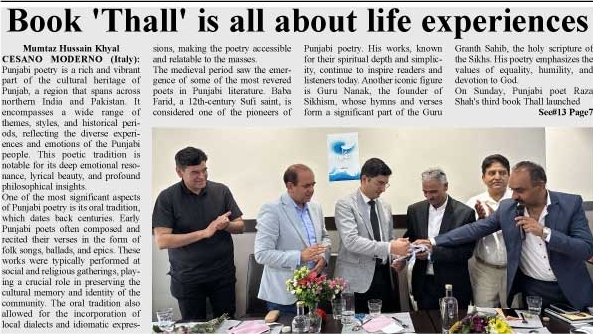
On Sunday, Punjabi poet Raza Shah's third book Thall launched here in Cesano Moderno. Halqa Adab-o-Saqafat Pakistan-Italy, organised a ceremony in his honor. The Chief guest was Ahmed Waleed, Deputy Consul General Milan, while honorary guest was Chaudhry Mahmood Asgher from UK. The president of this ceremony, Ahmed Naseer Malik also recited his poetry in Punjabi, and Urdu. There was a list of Punjabi poets including Muhammad Shraif Cheema, Chaudhry Anwar ul Haq, Faisal Butt, J.F. Ghori, Kamran Saeed, Ahmed Mumtaz, Professor Jespal Singh, Umer Farooq, and Chaudhry Shahid Nazir Gujjar, who recited their Punjabi poetry. In addition, Prof Jespal Singh said that we will encourage the talented writers to publish their poetry or literature from any language to Italian, English, or other languages. He urged that we must bring our youngsters to such programs-their participation is compulsory. Otherwise, they would not be able to understand this language.
The modern era brought new dimensions to Punjabi poetry, with poets like Raza Shah, Muhammad Sharif Cheema's poignant verses often explored themes of love, loss, and the human condition, while Raza Shah's lyrical compositions captured the pain and passion of youthful love, and political instability. Furthermore, Ahmed Waleed Deputy CG Milan said we will do our best to promote our art, culture, and artists.
Punjabi poetry is a testament to the linguistic and cultural richness of the Punjabi-speaking world. It has evolved over the centuries, reflecting the changing dynamics of society while preserving its core essence of emotional depth and lyrical beauty. Whether in the form of folk songs, spiritual hymns, or contemporary verse, Punjabi poetry continues to be a powerful medium of expression and a source of profound inspiration.